Institutions of higher education have the goal of helping people learn: acquire knowledge and skills. Academic accommodations are different resources, tools or modifications that allow them to access that knowledge and skills. Universities have processes in place to provide students access to such accommodations. The processes may be more or less convoluted and even in the best conditions require time and effort. It is a reactive process. It is to be accepted. As I mentioned in a post on inclusion, real inclusion is not to be accepted, it is to be expected. That makes a world of difference.
I’m sure you’ve seen the meme of equality vs. equity. Three people are watching an event from behind a fence. It shows an equality situation where everyone is given a small box to stand on. It helps the tallest person but the shortest still cannot see a thing. And then we have equity, where each person is standing on a box, of varied sizes, to allow all of them to watch the event. The tallest person doesn’t need it and is not provided a box.
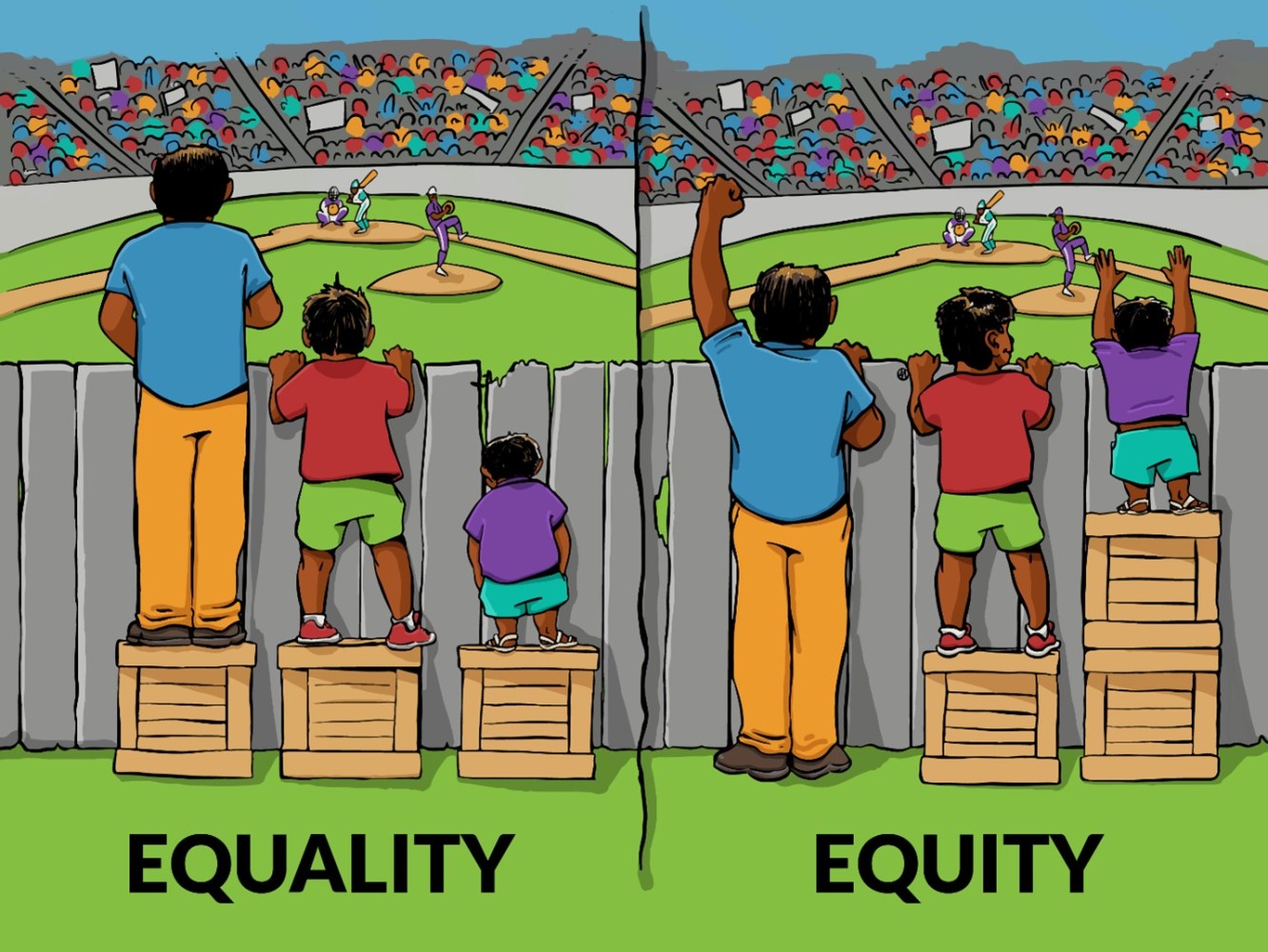
What is not mentioned is how they obtained the boxes, which could be seen as representing accommodations in college. Equity would mean that each person gets an accommodation that meets their needs. But what would this look like in practice?
In practice, the boxes would be in storage. You would get to this stadium to watch a game over a fence and discover you cannot see. Next, you would look around to find if there is something that may help you. Maybe you’ll be able to spot “oh, there are some boxes over there, I’ll go see if I can use one.” Or maybe there’s someone already using a box, and they tell you the box is useful and let you know where they got their box.
But the boxes are in storage, not just around for people to take them. You need the person in charge to be there, so you can explain what is happening, ask for the box, and for them to actually give you the box. But OK! You got your box.
You return to the fence, place the box on the ground, stand on it and… you still cannot see. You need a bigger box. You go back to the storage place, wait for the person to come back and explain what’s going on, they give you another box and finally you can stand on the two boxes and can watch the game.
There are many assumptions here:
- It was easy to figure out what to do – maybe there was a sign saying “if you cannot watch the game from here, and think you could use a box, go to the storage space located at…” or other people were helpful and told you that there are boxes available and where to get them.
- In the past, you had several interactions that went well and that makes you willing to go speak to the person in charge of the boxes.
- The storage place had enough boxes and the person in charge was there to give them to you and believed you without needing proof.
Even then, how long did it take you to get the box? How much of the game did you miss?
And…
- In many cases, it is VERY hard to find out that there are boxes available. And it may not even occur to you that a box could help. It may seem obvious to some, but it may not be for many people!
- Going to speak to the person in charge requires planning, good short term memory, being able to avoid distractions, etc., all part of what is called “executive function.” Many neurotypes or situations decrease executive function capacity, and wait times, or difficulty reaching out may frustrate people, in the end making them unlikely to look for accommodations.
- Many people who need accommodations are truly exhausted of having to explain their situation to yet one more person. They can feel it is a never-ending story. Additionally, their requests may not have been well received in the past and people may doubt their needs.
- Time is a precious commodity in college. You cannot afford spending too much time figuring out if this box works or if you need one that is sturdier or bigger. Time spent looking for the box may cost dearly in terms of engagement in class and grades.
Is there a better solution?
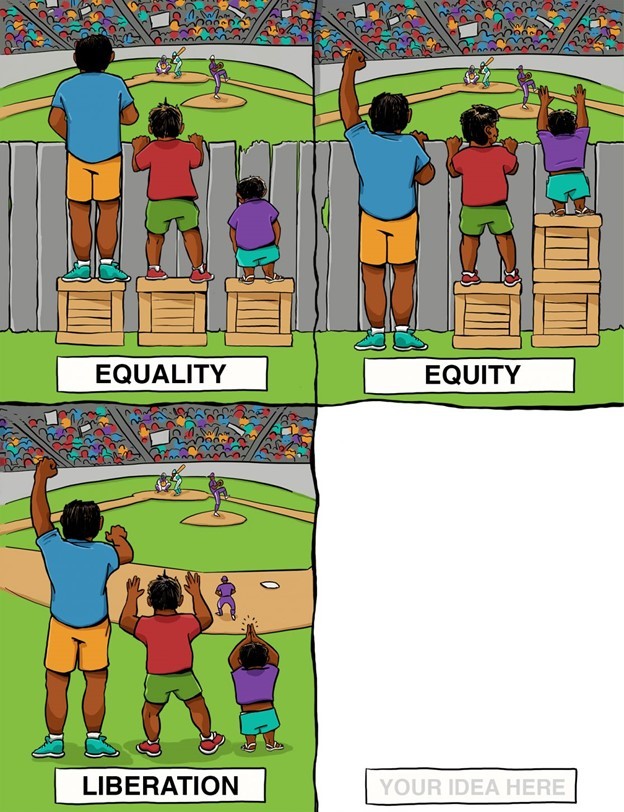
For the meme, the solution is called “Liberation” and it means not having a fence at all. For higher education, this could represent Universal Design for Learning. The content is accessible to the vast majority. We can brainstorm solutions for people whose needs we haven’t foreseen and add those resources or tools for everyone. If the goal is to have all students learn, we need to facilitate their learning since the beginning, without additional obstacles. That is what we should aim for!
 Florencia Ardon