Cornell University, where I work, has been realistic in that GenAI is here, for good or bad, and it’s better to teach students to use it to their advantage instead of simply prohibiting it. I fully agree.
I have been reading so much on the wonders of GenAI, and how now almost any job applicant needs to have experience using GenAI or else they will simply not be hired. But I’m still not actually understanding what it can really do.
So, I asked copilot. Below are portions of my conversation, and my thoughts about it. Copilot’s input is in italics.
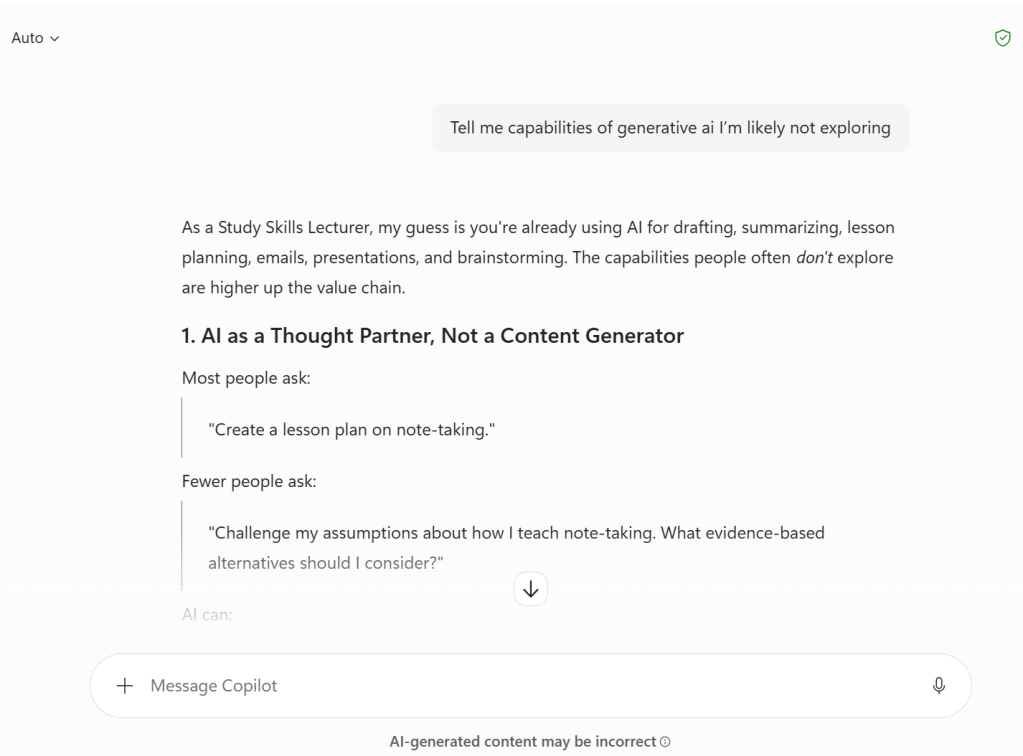
My prompt: Tell me capabilities of generative AI I’m likely not exploring
Copilot: As a Study Skills Lecturer, my guess is you’re already using AI for drafting, summarizing, lesson planning, emails, presentations, and brainstorming. The capabilities people often don’t explore are higher up the value chain.
Spoiler: I don’t use any of that. The main reason is that lesson planning, drafting, summarizing, presentations fall under what I consider to be my strengths. I would not use a teaching assistant to create that for me, much less would I give it to GenAI. Even when I get ideas from my colleagues who teach the same course I do a good amount of changes so that I feel comfortable with it. Brainstorming–one of my students mentioned in a reflection that he didn’t like the idea of using GenAI for brainstorming since it would most likely give you ideas that many people have. I don’t like brainstorming with real people for the same reason, as anyone who has posted a question on any internet forum can attest.
OK so what are the higher-value capabilities of Gen AI that could be useful for me? Copilot stated:
[use] AI as a Thought Partner, Not a Content Generator.
Most people ask: “Create a lesson plan on note-taking.”
Fewer people ask: “Challenge my assumptions about how I teach note-taking. What evidence-based alternatives should I consider?”
AI can: Play devil’s advocate, Stress-test ideas, Simulate stakeholder perspectives,Expose blind spots in plans, Generate competing approaches. This often produces more value than content generation.
This actually sounds good, and would not require much time investment on my side. I’ll give it a shot.
Build Personalized Learning Pathways.
Instead of creating one worksheet for everyone, AI can create: Tiered activities (beginner, intermediate, advanced), Student-specific intervention plans, Adaptive revision schedules, Personalized study strategies based on student profiles
Example: “Student is highly motivated but struggles with executive function and time management. Create a 6-week support plan.”
Sounds worth testing out
Simulate Difficult Conversations
You can role-play: A disengaged student, A frustrated parent, A skeptical department head, A struggling first-generation student, A student facing academic probation
This is surprisingly powerful for coaching and preparation.
Here the skeptic is me. I feel this part would not be really useful, at least for my taste. I’ve found that people (especially neurodivergent people) are way more nuanced than this. Meaning, there are hundreds of ways a student may be disengaged. Instead of using GenAI, I prefer going to the actual source. I do work hard to create trust with my students.
Turn Expertise into Reusable Systems
This is a big one. You likely have expertise that lives in your head: How you diagnose student challenges, How you coach time management, How you help students recover from poor grades.
AI can help convert that into: Playbooks, SOPs, Decision trees, Conversation guides, Training materials.
This scales your expertise.
OK, this sounds useful.
Create Synthetic Case Studies
Instead of using generic examples, generate realistic scenarios: Students who procrastinate, Students balancing work and study, High-achieving students experiencing burnout, Students returning to education after years away. These become excellent discussion and training resources.
I’ll give it a try. Similarly, I would be OK with using GenAI for my own reflective and professional growth, as well as organizing student support strategies, workshop materials, etc., though I’m not as sure about this one. The last idea from Copilot was for me to create a “reusable AI assistant” for lesson design, workshop generation, etc. which again, I pride myself in doing really well.
Analyze Patterns Across Large Amounts of Information
Many people never upload or paste large collections of: Student feedback, Reflection journals, Survey results, Assessment comments
AI can identify: Recurring themes, Hidden concerns, Sentiment trends, Frequently misunderstood concepts
What would take hours can take minutes.
Copilot said something similar regarding student feedback about the course.
I would never upload students’ reflections to GenAI. If it were an app in my computer that doesn’t touch the internet, then sure. But at this point, no. And by the by I think there should be guidance related to the protection given to students by the Family Educational Rights and Privacy Act (FERPA). I believe uploading their reflections to GenAI (even Copilot, for which Cornell has a contract that keeps the information uploaded within the Cornell environment) would violate FERPA.
I asked Copilot what I’d need to do to respect students’ privacy if I share their essays with GenAI. It gave me a lot of info, so I’m summarizing. In addition to use an institution-approved tool, which I was already doing, Copilot said to remove identifying information (name, id, etc) and that if an essay discusses highly personal circumstances I should summarize them instead of sharing them verbatim; share only what I need; asking the GenAI to not attempt to infer the students’ identity, remove medical information, mental health details, disability information, immigration status, financial hardship details, etc. And, of course, to be transparent and tell my students I’m using GenAI.
I got tired just reading all that I would need to do to safely upload information! Preparing students’ essays for analysis by Copilot would require for me to read the essays and determine what to share and what not. If I’m already reading them, I may as well just respond myself, which is what I’m doing, and not risk having their thoughts online. Using GenAI to grade or to seek patterns in my students’ essays is a NO.
Additionally, Copilot says that it would give me coaching insights. Honestly, I think I’m better at coaching my own students than Copilot would ever be, especially because Copilot doesn’t speak to them, has not been in touch and witnessed the development of thousands of students over time, like I have, and simply doesn’t have my personal touch, which I believe to be one of my strengths. It also goes against my values in many ways.
Maybe I’m too old? At this point I feel that it’s just not worth it for me. Would love to hear your thoughts, especially if you work as advisor or instructor in higher ed.
 Florencia Ardon